

Biochar, Wood Vinegar and Wood Tar Producer
Rooted in Nature. Built on Science.
Biochar, pyroligneous acid, organic tar and activated carbon solutions made with controlled pyrolysis technology.
Patented Reactor
700°C
Pyrolysis without oxygen, designed by our own R&D team
TSE K 665 · K 683 · K 684
Standard setter
Ministry of Agriculture and Forestry · Ministry of Health
Approved licences and permits
EU Mission Ocean and Waters
Registered under the mission
Low Carbon Hero
Award · ITU Ayazağa
Pick your problem, see the right product and its proof.
In three steps, get the product, dosing protocol and evidence for your sector and problem.
01Sector
02Problem
03Recommended solution
Product
- Application dose
- Foliar: 1:300 (≈ 0.33%), every 15–20 days · Soil: 1:500 (≈ 0.2%), via drip irrigation
- Effect
- Stimulates root development in seedlings, facilitates nutrient uptake in soil (especially nitrogen and phosphorus) and enhances fruit set
Product
- Application dose
- Field crops: 100–200 kg/da before sowing · Greenhouse: 0.5–1 kg/m² · 1–5 kg per tree
- Effect
- Increases the soil’s water retention capacity and aeration; saves 20–40% of water when combined with drip irrigation
Product
- Application dose
- Soil: 1:200 (≈ 0.5%), every 15–20 days · Foliar: 1:500 (≈ 0.2%), every 20–30 days · Hydroponics: 1:1000 (≈ 0.1%)
- Effect
- Lowers the pH of soil and water, improving nutrient availability for plants
Product
- Application dose
- Undiluted, thin layer · with a brush or spatula · while the plant is dormant or in early spring, usually a single application
- Effect
- Insulates the wound surface from air and moisture and reduces water loss; improves graft take and speeds recovery after pruning
- Official proof
- TGSKMAE wood tar analysis (24-OG-00140) · TSE K 683
- Application dose
- Added to the daily feed ration: cattle 0.5–1% · sheep and goats 0.5% · poultry 0.2–0.5%
- Effect
- Improves feed conversion and lowers ammonia in manure, reducing odour and environmental pollution
- Official proof
- Banvit integrated-facility pilot study · Ministry feed additive licence
- Application dose
- Added to the daily feed ration: cattle 0.5–1% · sheep and goats 0.5% · poultry 0.2–0.5%
- Effect
- Acts as a toxin binder for mycotoxins and heavy metals, balances gut flora and enhances nutrient absorption
- Official proof
- Ministry of Agriculture and Forestry feed additive licence
Product
- Application dose
- In drinking water: cattle 1–2 ml/L · sheep and goats 0.5–1 ml/L · poultry 0.2–0.5 ml/L · daily, or 5 days on, 2 days off
- Effect
- Encourages water intake and reduces microbial build-up in water lines; supports digestive health
- Official proof
- TSE K 665 criteria conformity certificate (wood vinegar)
Product
- Application dose
- Thin layer on the cleaned and dried area · once a day for 3–5 days · once a week for prevention
- Effect
- Maintains skin integrity; prevents fungal infections, rot and cracks in the sole and hoof area and reduces fly-induced irritation
- Application dose
- 1:100 (≈ 1%) · 1:50 (≈ 2%) for heavy soiling · spray or wipe
- Effect
- Suitable for feeders, water troughs and hoof baths; suppresses ammonia odours
- Application dose
- 1:100 (≈ 1%) · 1:50 (≈ 2%) for heavy soiling · spray or wipe, no rinsing required
- Effect
- Prevents bacterial growth and suppresses fungi and algae in pools, showers and changing rooms
- Application dose
- 1:100 (≈ 1%) · 1:50 (≈ 2%) for heavy soiling · spray after daily cleaning
- Effect
- Reduces pathogen load, controls odour and slows biological decomposition
- Application dose
- 1:100 (≈ 1%) · 1:50 (≈ 2%) for heavy soiling · spray onto floors and walls
- Effect
- Suppresses bacteria and fungi in animal housing and reduces ammonia odours
Product
- Application dose
- Brush, roller or spray on a clean, dry surface · dilute with 10–15% solvent if needed · dries in 24–72 h · annual inspection on metal
- Effect
- Forms a water-repellent layer that reduces oxygen contact and prevents rust; protects the waste-contact surfaces of containers against wear
- Official proof
- TGSKMAE wood tar analysis (24-OG-00140) · TSE K 683
- Application dose
- Brush, roller or dipping on clean, dry, dust-free wood · 1–2 coats, at least 24 h between coats · at least 48 h to dry fully
- Effect
- Penetrates deep into wood to prevent decay, fungi and mould; protects wood against termites and other wood-damaging pests
Product
- Application dose
- Brush or spray onto the cleaned underwater hull · dries in 24–72 h
- Effect
- Biological protective coating against barnacles, algae and marine borers; forms a natural anti-fouling layer on wooden boats
Product
- Application dose
- Field crops: mixed into the soil before sowing, 100–200 kg/da · 1–5 kg per seedling or tree, into the planting hole or under the canopy
- Effect
- Turns carbon into a stable form that bacteria and fungi cannot easily break down; biochar can remain stable in soil for hundreds or even thousands of years
Product
- Application dose
- The cube is placed in the soil; the seed sprouts under suitable moisture and temperature · seed species chosen by season and region
- Effect
- Its biochar locks in carbon for the long term while the tree seed grows into a new sapling; over 90% sprouting and tree growth rate compared with conventional seeding
Product
- Application dose
- Project-based · carbon credits are separate from the physical product
- Effect
- Partners who buy the credits can support their climate commitments with a traceable, auditable carbon solution
- Official proof
- Puro.Earth and EU Clean Carbon Registry pre-registration
From agricultural waste to three valuable products, with zero waste.
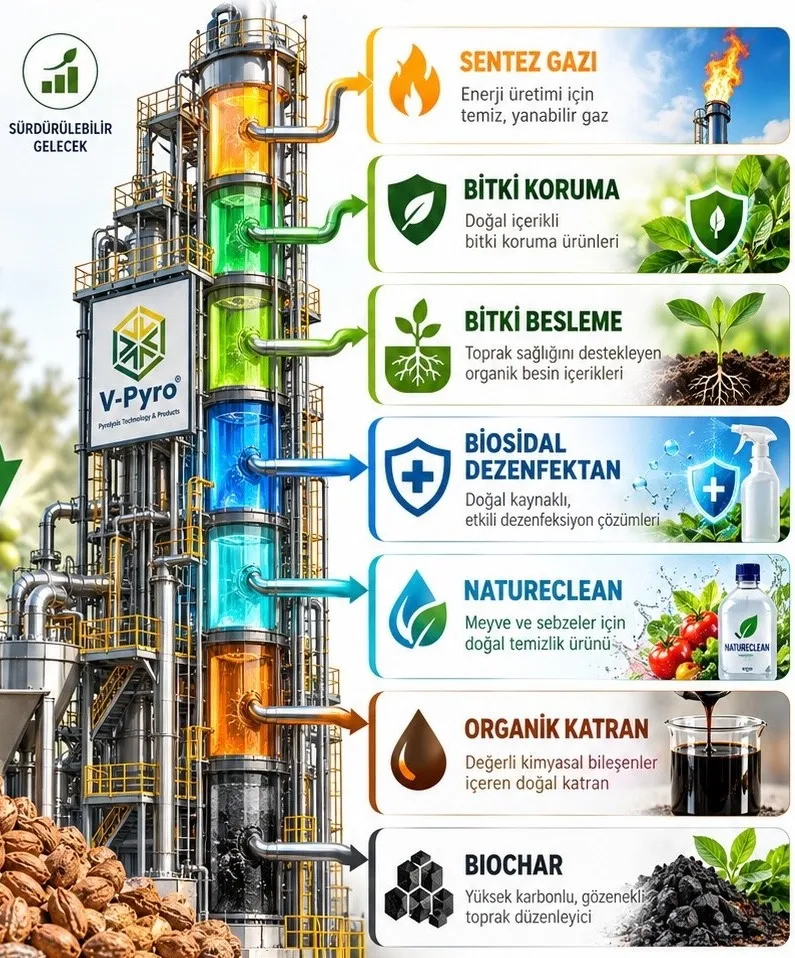 Enlarge image: Turkish-language infographic of the V-Pyro pyrolysis column, which yields syngas, plant protection and plant nutrition products, a biocidal disinfectant, NatureClean fruit and vegetable cleaner, organic tar and biochar (opens in a new tab)
01 · Feedstock
Organic agricultural waste
- Olive pits
- Walnut shells
- Apricot kernels
02 · Pyrolysis
700°C
Thermochemical decomposition without oxygen. Patented, locally built reactor with a biomass conversion capacity of 300,000 kg.
TÜBİTAK 1505 · 1832 Green Transformation
03 · Products
- Solid phaseBiocharCarbon Fertilizer · KARBOVITAL · Carbon Cube
- Liquid phasePyroligneous AcidPlant Growth Regulator · NUTRIWOOD · pH Regulator · Phenolic Feed Additive · Natural Disinfectant · Skin Care Spray
- Heavy fractionWood TarBLACKBARRIER · Wood Protector · Grafting / Pruning Paste · Skin Care Paste
What are biochar, wood vinegar and wood tar?
At its Mersin Agropark / Tarsus plant, V-Pyro splits agricultural waste such as olive pits, walnut shells and apricot kernels into three product phases by oxygen-free pyrolysis. Biochar, the solid phase, is a plant-based soil amendment that retains moisture and nutrients and stores carbon in the soil for the long term. Wood vinegar (pyroligneous acid), the liquid phase, is a natural fertiliser and biostimulant that promotes plant growth. Wood tar (organic tar), the heavy fraction, is dark and viscous, rich in hydrocarbons, acids and phenols, and forms a protective, water-repellent layer. The whole product catalogue is 100% natural.
The products serve five sectors. In agriculture, wood vinegar and biochar support plant growth, stress tolerance and water and nutrient retention, while wood tar is applied to graft and pruning wounds. For livestock there are feed and drinking-water additives, non-medicinal skin care and barn hygiene products. In food safety and hygiene, a natural wood-vinegar disinfectant provides surface hygiene and odour control. In industry, wood tar protects wood and metal surfaces and boat hulls. In carbon and climate work, biochar is used for carbon removal and, in the Carbon Cube, for afforestation. Solutions by sector matches products to sectors; sector pages give application rates.
Accredited laboratory tests and scientific studies are in Science & Data; the test reports, analyses and certificates page lists each document's issuer, number and date. Product standards: TSE K 665 (wood vinegar), TSE K 683 (wood tar), TSE K 684 (biochar).
Results measured and reported in the field.
While turning waste into value, we cut water use, pesticides and carbon emissions together.

350,000 kg
Biomass processed
262,500 m³
Irrigation water saved
1,750 kg
Pesticide use avoided
245,000 kg
Carbon emissions prevented
Proof from the Field
“An 85% field effect of wood vinegar on Fusarium suppression and root development in a greenhouse application.”
- Field suppression effect
- 85%
- Standard-compliant product
- TSE K 665
Reach our products at your nearest point of sale.
No dealer near you? Call +90 444 81 33 to find your nearest point of sale.
See all dealers by province →